
Yarn Weights Explained Without the Confusion
Separate thickness category from package mass, then use label values and a washed sample to compare yarns.
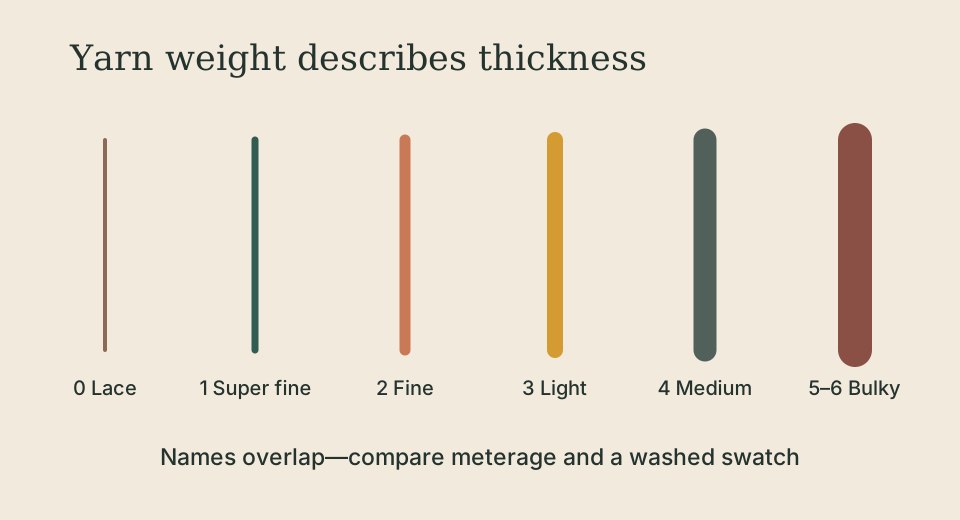
On a yarn label, “weight” can mean a thickness category or the mass of the package. A 100 g ball and a category 4 yarn answer different questions. Keep those facts separate before comparing two products.
Use the category to narrow the choice
Category names help locate broadly similar yarns, but they do not specify an exact diameter or guarantee the same fabric. Construction, fibre and the way the yarn opens in a stitch can change coverage and drape even within one category.
Copy the label's length, mass and suggested tool range, then make the intended stitch. For a substitution, the useful outcome is a compatible washed sample, not simply two labels bearing the same category number. The comparison below shows which label values serve which purpose.
Read thickness and package weight as separate facts
A ball marked 100 g states the mass in the package. A category marked 4 describes a broad yarn-thickness family. These are not competing measurements: a 100 g ball can contain thin or thick yarn, and two category-4 yarns can have different lengths per ball.
To compare labels, put both lengths over the same mass. Yarn A with 200 m in 100 g has 2 m per gram. Yarn B with 150 m in 50 g has 3 m per gram. Yarn B provides more length for the same package mass, but fibre density and construction still prevent this ratio from proving that the fabrics will match.
Make the label lead to a sample
Choose the approximate category requested, then use the pattern stitch and suggested hook for a swatch. Measure after the intended wash and drying method. If the count matches but the fabric is too stiff or too open, the substitution may still be unsuitable. Our complete numbered chart separates category names from crochet gauge; do not use a knitting gauge as though it were a crochet gauge.
Reference: Yarn categories. Examples on this page are planning calculations, not measured results from a finished project.
Compare yarns within a weight category
Use the intended stitch and record each actual label. A shared category is a starting comparison, not a substitution guarantee.
This blank worksheet is for your observations. It is not a record of a project tested by this publication.
Saving is optional and replaces this guide's previous saved record on this browser. Download first to keep multiple samples. This tool does not submit your notes to the publisher. Avoid private information on a shared device. Unsaved changes disappear when you leave.