
Fabric Grain Explained
A pattern piece placed slightly off grain may twist after washing even when every seam was sewn accurately. The direction of the cloth was carrying tension unevenly.
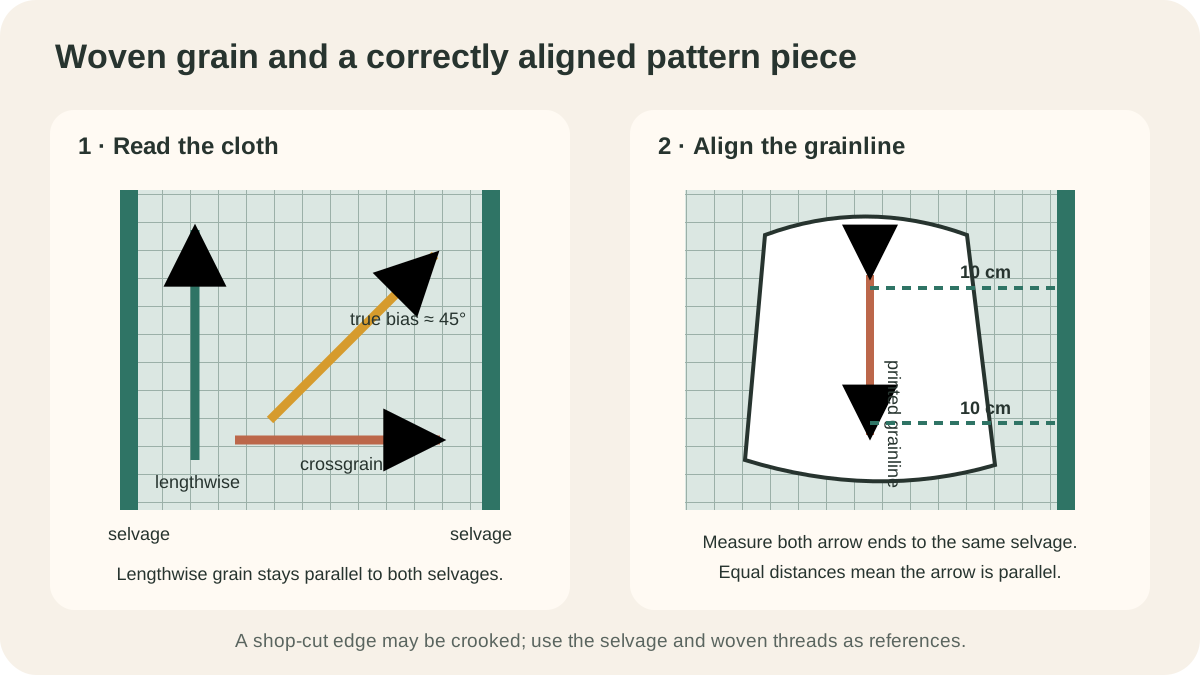
On woven fabric, selvages run along the length, lengthwise grain runs parallel to them, crossgrain runs from selvage to selvage, and true bias lies at 45 degrees to both grains.
Selvage, lengthwise grain and crossgrain
Selvages are the firm factory-finished edges created along both sides of a woven cloth. The lengthwise or warp threads run parallel to those edges and usually have the least give. Crosswise or weft threads travel across the fabric width and may yield slightly more.
The edge cut in a shop is meant to run across the width, but it is not a trustworthy crossgrain reference. It may be crooked or stepped because the cloth shifted while it was measured. Use the selvages and visible woven threads to establish direction.
True bias is a direction, not an edge
True bias lies halfway between lengthwise grain and crossgrain—45 degrees to both. Even a non-stretch woven fabric can extend and drape along this direction. That behaviour is useful for bias binding and fluid garments, but bias-cut pieces need gentle handling because hanging and pressing can lengthen them.
Align a pattern grainline with two measurements
- Lay the fabric flat without pulling it and identify one selvage.
- Place the pattern piece roughly in position with its printed grainline arrow running lengthwise.
- Measure at a right angle from one end of the arrow to the selvage.
- Measure from the other end of the same arrow to the same selvage.
- Pivot the pattern piece until both measurements are equal, then pin or weight it without shifting.
For example, if one end is 10 cm from the selvage and the other is 11.5 cm away, the piece is not parallel. Keep the 10 cm end still and move the other end until it also measures 10 cm. Measure from the arrow itself, not from the irregular outline of the pattern piece.
What off-grain fabric does
A woven piece cut off grain may twist around the body, hang toward one side or make seams rotate after washing. If folded selvages align but a crosswise fold will not lie smoothly, the fabric may be distorted. Follow the fabric-care guidance before attempting gentle straightening; do not force printed motifs or permanent finishes into a square they cannot hold.
Knits do not have woven warp and weft in the same construction. Identify the direction of greatest stretch, the vertical wales where visible, and any recovery or one-way design. Place pattern pieces according to the pattern's grainline and stretch-direction markings rather than applying woven-fabric rules blindly.
Correct grain placement is quiet evidence: the finished piece hangs as intended, matching edges meet without torque and the fabric's stretch appears where the pattern expects it.
Distinguish grain from a printed stripe
A print can sit slightly off the woven grain. Aligning every piece only with the printed motif can therefore change how the garment hangs. Compare the pattern grainline, selvage and actual threads before deciding whether the cloth is suitable for a design where matching is prominent. Do not force a print straight by stretching the cloth permanently out of shape.
When laying a piece on the fold, measure the printed grainline or specified fold edge at more than one point. A long fold that curves across the table is not a reliable straight reference. Keep the cloth supported and flat so its own weight does not distort the layout.
Before cutting several copies, mark the chosen top direction on the first paper piece. Grain-parallel pieces can still face opposite ways; nap and one-way prints may require the same orientation as well as the same grain. The cutting-layout example shows why those restrictions change yardage.
Reference: Sewing & Craft Alliance: preparing fabric. Examples on this page are planning calculations, not measured results from a finished project.
Mark direction before cutting
Keep the selvage and intended top direction visible. Do not rotate pieces unless the pattern and fabric permit it.
This blank worksheet is for your observations. It is not a record of a project tested by this publication.
Saving is optional and replaces this guide's previous saved record on this browser. Download first to keep multiple samples. This tool does not submit your notes to the publisher. Avoid private information on a shared device. Unsaved changes disappear when you leave.